Wednesday, October 3, 2012

Post-foodem: Michaelmas Lunch

So Wolfmom and I coined a term after Michaelmas, post-foodem. It's where the cook breakdowns what went right and what went wrong, and talks about what he or she learned from the process. I usually do this myself in my nifty brown book, but as this blog is for similar purpose (and sharing with my readers) I decided I'll be updating this here as well.


What went right:


  • Pre-planning was a huge key. Testing out the recipes and seeing what tasted good/what tasted off helped me with the final chicken product. Lots of communication with the Feastcrat and my mentor Wolfmom meant that I had a good idea on timetables/kitchen use and equipment to bring or would be provided.
  • Working with the Feastcrat for ingredients once again payed off. I was able to get a good chunk of chicken for cheap because she was purchasing chicken herself, which allowed me to purchase extra fruit to be consumed and keep the price low at 3 dollars.
  • The price point again seemed to be my big seller. At 3 dollars I wasn't asking for a terribly large amount of cash, so people seemed more eager and willing to pay it than had I offered upwards of 5 dollars. This was a strong factor in me selling out of lunch I feel.
  • Largess for all my volunteers was a great idea Not only did it make them feel good and appreciated, that I would given them some jewelry pieces for their hard work meant I had the same people volunteering to help ALL day and night, but it made me feel good to see them happy and ejoying the items I gave them. Heck, one young boy went ahead and made a necklace that day with the beads and pendant I gave him!
  • As far as the Luncheon goes, the table display was fantastic and really helped to set the mood. I had a couple judges come up to me and thank me for the spread, it looked just as visually appealing as it tasted, and I could not have pulled that off without the help of Thalassia who was able to come up with the roman-themed decor at the last minute to help.


What went wrong:

  • Assumptions were the biggest issue, overall. A few people who volunteered to help got pulled away at the last minute, which meant my timetables were in threat of going eyry. Thankfully I had started early and had extra volunteers on had to cover what I needed, but had neither of hose things happened I could have been in a pickle.
  • My math measurements were off, which was frustrating. I ran out of grapes before I did melons, which I shouldn't have had I done my math a bit better on my portioning. I know exactly what went wrong there, grapes don't fill a ladle because their solids and I'm a doofus for thinking otherwise, so that's an easy fix. I also ran out of wax paper wrap 8 sandwiches early, but that's because the bread was a bit wider that I had thought and took an extra inch of paper to cover properly.
  • Not having eyes on the Royals and Baron/Baroness was a pain. My contact with where they should have been had lost track of them, to make matters worse they had split up from where they were supposed to be so I had to send runners to locate them to bring them lunch.


Lessons learned:


  • Prepare enough largess to give to folks, its a great way to make them feel good about thier service for you and to earn you repeat volunteers when you sddeny find yourself needing to send runners across camp to locate royals.
  • Did I mention pre-palnning enough yet? Every time I've done it (all of 3, I know) it's paid off in spades, just mentioning again so I don't forget it.
  • Don't assume people will be there. Plan for them being distracted, taken away on another more important job or even just not on site yet. 
  • Stay hydrated! I got a little dizzy around 10am that day from lack of water, I made sure to sit and drink and felt right as rain shortly.
  • Don't be afraid to ask for help, because people are always willing to do so if they're able!
  • People may not have the same tastes as you, do keep your fruits separated because people don't want their grapes and melons touching (Thanks Madhavi for that one!).
  • 5 days in advance is a slightly stressful time to try and throw together decor and setting for a judges luncheon to match your period-style lunch.

Monday, October 1, 2012

Storytime: Gate Duty

This story is dedicated to all of those hard working SCA members who spend countless hours manning our gates at events. Yours is an incredibly hard and often boring job, but necessary and I felt the best way to honor that work would be in this little bit of fiction.


* * * * * * * * * * * * * * * * * * *

David Archer woke before the cocks call, sitting awake and alert as he did every morning. He slowly slipped from his bed, giving his lady a gentle kiss on the forehead to calm her as she stirred, before striding to his chest. He withdrew his simple clothes, making a mental note to have his lady repair a few threadbare patches, and dressed himself silently.

The glow of the Sun had just begun to creep over the treetops as David left the encampment. The only other person awake at this hour was Christoff, his shuffling stride towards the Feast Hall to continue the work of cooking the only visible track in the dew-soaked grass of the early morning. Allowing himself a yawn and a stretch, he likewise shuffled his way to the war wagon, withdrawing his arms and armor with ease. Dressing himself for battle, he slung his shield and sword over his back and marched the rest of the way to the massive gate that provided entrance to the greater Kingdom encampment as a whole.

Giving a grunt and a nod to the other gate guards, David relieved them of their posts and kept a wary eye as they shuffled off to sleep. Today was the day of a grand tournament, the King had lost his heir in the great War many years ago and many pretenders to the role clamored to be named heir to Trimaris. The King, wise and honorable, knew only his true heir could be victorious in the eyes of God and King so he established a tournament of arms to find his long lost heir. From all around Trimaris the populous would flow in, this was a grand spectacle that rarely occurred many times in a lifetime.

James and Adriano had both scoffed at David's insistence on taking so many shifts of gate duty, but allowed their brother to have his fun while they had theirs. As he settled in for a long morning, he heard the familiar sounds of Christoff's wagon being pulled along the dirt road and the wafting smell of fresh cooked meat. Smiling, he relaxed and laid his arms against the great gate. "Good morning Christoff, one day I think I shall wake before you do."

Christoff gave a chuckle, shaking his head at the Englishman. "I think not friend, this many of our countrymen here requires little sleep and much vork. I have brought ye breakfast though."

David grinned and eyes closed at the smell of the baked pork and strips of egg. He sat down along the road and began to eagerly dive in, happy that Christoff had brought him that Middle Eastern bean drink his Laurel had taught him of. Having his fill, he saluted the cook off and watched as Christoff wheeled his way to the next set of deliveries.

Before he could adjust to the full stomach and the hot beans could awaken him fully, David was startled as he felt a large brutish hand grasp the base of his neck and throw him into a tower. It seems a Troll had taken to moving into this valley, and the beast began to rage as it walked near as the smell of so many Christians sent it into a hunger frenzy. Unable to grasp his blade of helm, David scrambled to his feet as he pulled up his tower shield and promptly slammed it into the nose of the troll. The beast fell back and snarled, moving to grasp and squeeze the life out of David but he was too nimble and once again slid out of the way to slam the heavy shield into the shins of the beast. This game of cat and mouse carried on for several minutes before the first rays of sunlight poked through the trees. The sun had the affect David desired, instantly turning the beast to stone as it was in mid stride and ending its rampage.

Panting, David dropped the shield and caught his breath. Looking up at the fierce some creature now nothing but a stone statue, an idea sprung to mind. He sent a message via courier down to the children's hall to ask them to come paint the new statue as a gift for Their Majesties and then with a incredible show of strength drug the statue off the road and away from traffic.

Requiring his arms and helm, David Archer finally began his long day of action. As the sun rose high above the trees, peaking with rays of warmth that melted the fog, the first travelers began to pour in for the grand tournament. Much of the morning was spent simply waving and greeting, with the occasional check of a wagon or wildlife changed up the monotony of it all. The day seemed to be going smoothly, with reports that the Kings caravan was within a 2 hours walk David was hopeful that the trouble had already passed and the rest would be an easy day. If only.

Just before lunch and his relief was to arrive, a cry of fear arose from the caravan traveling in. A runner approached, eyes wide and said a wide wyvern had barreled out of the sky and was eating the oxen of some of the travelers. With the King just beyond the hill, David knew he did not have time to waste to protect not just the tournament but his King and Queen as well. David shelled off his armor and weapons, knowing the smell of iron angered the beasts, and ran as fast as his long legs could carry him.

The wyvern was beautiful, scales gleaming and wings wide and strong as it feasted happily on the oxen beneath its deadly claws. David kept a careful eye on the creature as he approached, knowing he would only have one chance. Running had caused him to sweat, and the smell of iron was rinsed from his body thus so sneaking up was thankfully an option. As he got close the wyvern suddenly snaked its head around to gaze at David, and without hesitating he knew he had to make his move. He leaps, the animals eyes blinking in surprise at the man who would dare to attack it. Before the beast could react David had his tree branch arms around its throat, grasping and squeezing tightly to try and knock the beast out. The wyvern struggled, throwing its neck back and forth and even slamming poor David onto the ground, but it dare not use its own claws for fear of killing itself. Minutes felt like hours, but finally the great beast ran out of air and with one last struggle collapsed unconscious on the ground.

Standing shakingly, David dusted himself off and winced at the bruise on his back. He turned to the owner of the now dead oxen and bowed. "My apologies on the loss of your oxen Milord, I will send a runner with a fresh team to pull you inside. If you wish, strap this beast down and take it with you inside. It will sleep for hours, and the Baron of Wyvernwood pays well for these captured and brought to him, enough to get a new team."

The man bowed and David limped back to the gate, grunting as he collapsed on his bench with his armor piled at his feet. Within minutes the sound of the Kings trumpets blared and he quickly redressed himself so he could salute and greet the King to assure him all was well with the tournament and the populous. The King smiled and thanked David, pulling a ring from his hand and personally placing it in the thankful mans hand.

As the King and his caravan road in, from behind him the soft footprints of his lady greeted him. He turned and gave her a chaste kiss, taking the plate of lunch from her and setting it on the nearby wooden table. David then allowed his relief guards come, taking over the gate duty so he could sit and enjoy a meal.

"I don't know how you can do this all the time, gate duty is so boring. Anything exciting happen yet, husband?" Adelyn asked as she nibbled on a section of cheese.

David gave a shrug and took a large bite of the beef. "Nothing unusual, just the same job as always."

Sunday, September 30, 2012

Apprentice


Life has a strange way of working out sometimes, of just having things come together in such a way that you have to marvel at the beauty of it. This weekend was a joining of the strands, of seemingly random occurrences and happenstance meetings drawing people closer and into new and exciting adventures together.

I first met Mistress Madhavi last year at Res Vesteria, on what she calls one of her worst days ever. I was inspired by her command of the kitchen in the line of fire, awed by her culinary skill and encouraged when she was willing to listen to my suggestions and even implement them in the meal. I left that event uplifted, excited and jabbering all the way home to my friends at the amazingly cool person I had just met. I next ran into her at Fall Coronation 2011, at the end of the feast she went out of her way to come find me. I was humbled that she remembered me, she personally thanked me again for my work with her at Res Vesteria and said she would love to work with me again anytime. I found out she had been made a Laurel that day before I arrived to site, and I remarked to my friend Jake that if I were to ever take a belt I would want ti from her.

That first real communication, the thanks and the promise of future work inspired me. You can look back on my blog from last year and see the sheer number of cooking entries I did as I tested making my own period recipes. I was consumed with a passion for the culinary arts and every event and every art/sci I found a way to attend/enter just made me more inspired. I began to research my persona and my garb, study my culture and my food. I sat down and just wanted to absorb SCA culture and history, sometimes sitting by the fire for hours as I just listened to the stories of yesteryear. When Kingdom Art/Sci rolled back around and I found that Mistress Madhavi was one of my judges, I was a ball of nervousness and anticipation. Not only did it go well, but she invited me to cook and do even more with her at Gulf wars!

Gulf Wars was amazing in so many ways that I still can't even describe it all. I got to know Mistress Madhavi and so many other amazing people even better, I had a wonderful cooking experience and I worked up the nerve to ask to be Madhavi's student. We talked about it and she accepted me on, I tried not to have a gigglefit in front of her and saved that for private over booze with Ever. Having someone there as a teacher was a really great thing for me. Now I had someone whom I could regularly pester with questions in relation to food whenever they came up, someone to confide in with my concerns and someone I could rely on to be there for me whenever I needed it. I've had various friends who filled that roll for me, and still do, but this was something unique and special for me and it satisfied me in so many ways I feel stupid for rambling about.

At Fall Coronation this year, Madhavi (after insisting she have her full plate of cupcakes before talking to me) asked me to be her apprentice. She asked me to help her form a household, and asked me to start the journey to being a Laurel. I was so taken aback and stunned that for a minute I just sat there in silence staring at the kitchen, staring at the oven long enough that she asked me if I had changed my mind about wanting it. I quickly reassured her no, that it was something I deeply wanted and was just honored and floored to have been asked. We discussed a few things, then agreed to be quiet about it until she belted me at Michaelmas after feast.

The belting ceremony was everything I could have wanted. It was small and intimate, there were piles of food and booze around as Quan had been cooking all night for this. The moon was bright and full in the sky, no clouds, and the air was pleasantly warm. Not only were Quan and my Lady there, but we was also joined by Wolfmom and Countess Sibilla. Both of these lovely ladies ave been a real inspiration o my SCA time so far, and having my first Queen overseeing my belting made my vision water a little. Madhavi asked me for three promises to her, three she would hold me to then gave me three she would make to me and expect me to hold her to in return. The belt she tied me with was her own apprentice belt, in accordance with custom it seemed, and even though she said she could make me a less girly belt I wouldn't want to trade this one for anything. After that was done, she held up a raksha bandhan and asked for my right arm. She tied the jewelry to my wrist, explaining that this symbolized she would always look after me and defend me for to her I was her little brother and before she tied the knot on it she asked if I would do the same. Both of us got a little watery-visioned at this point and I nodded, she tied the knot and that was that.

Drinking and talking and partying then was in order. Stories ere told and I was honored as the Excellenices of An Crosaire and the Empress both arrived with the intention of congratulating me and Madhavi. I was so overwhelmed at this point I needed to go for a walk, I don't do well on emotional overload and I went into the woods and just sat and cried for a few moments. I hadn't felt so welcomed, so appreciated and so much at home in such a long time tat I didn't know how to handle it but with a few happy tears and laughter against an oak tree. I visited a few friends, then made my way back feeling light as a feather and ontop of the world.

There will be more writing about this event this week, but I needed to get this off my chest and onto this blog for my own memories. Than you for those taking this journey with me.


Friday, September 28, 2012

My Michaelmas A/S Report :)

ID #: 092686CC                                                        Name: Christoffer Koch
Category: Food preparation                                         Division: 5; Domestic Arts and Sciences


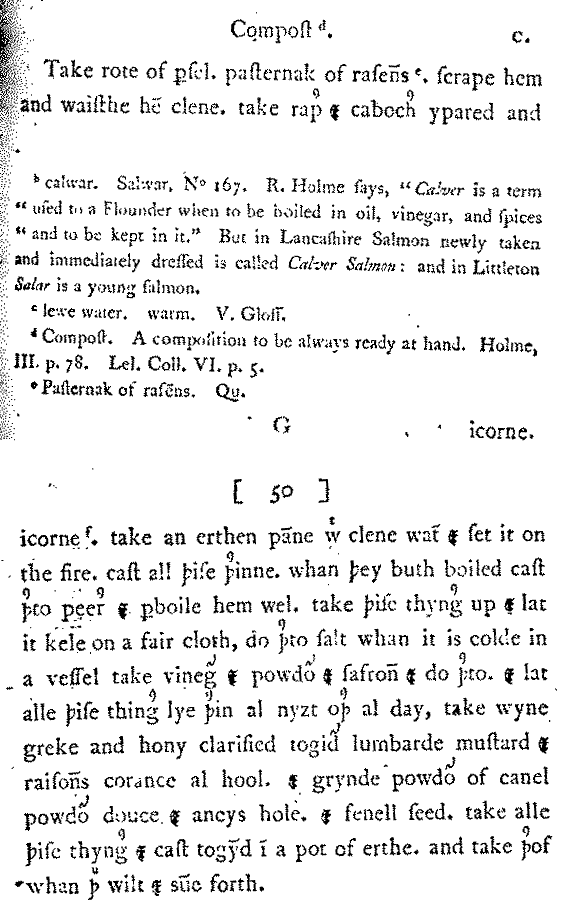
Compost - A Recreation from Forme of Cury

Originating from England, the cookery text this recipe hails from around 1390 A.D. is entitled Forme of Cury. This roll of recipes were compiled by the Master-Chefs# of King Robert the II, and thus is a listing of foods cooked for the royalty and nobility of England.


Compost (from Forme of Cury) -

Take rote of parsel. pasternak of rasenns. scrape hem waisthe hem clene. take rapes & caboches ypared and icorne. take an erthen panne with clene water & set it on the fire. cast all þise þerinne. whan þey buth boiled cast þerto peeres & parboile hem wel. take þise thynges up & lat it kele on a fair cloth, do þerto salt whan it is colde in a vessel take vineger & powdour & safroun & do þerto. & lat alle þise thinges lye þerin al nyzt oþer al day, take wyne greke and hony clarified togider lumbarde mustard & raisouns corance al hool. & grynde powdour of canel powdour douce. & aneys hole. & fenell seed. take alle þise thynges & cast togyder in a pot of erthe. and take þerof whan þou wilt & serue forth.

Translation (as translated by myself) -

Take the parsley and parsnip and scrap and wash them clean. Take turnips and cabbages and cut them up. Take an earthen pan with clean water and set it on the fire. Cast all of this inside. When they have boiled, cast pears in and boil them well. Take these things up and let it cool on a fair cloth, add salt when it is cold. In a vessel take vinegar and powdour and saffron and let  these things lie there in all night or all day.

Take greek wine and clarified honey together with mustard and whole raisins and grind cinnamon powder, powder douce and whole anise and fennel seed. Take all of these things and cast together in an earthen pot. Take thereof what you will and serve forth.

Redaction (as done by myself) -

Main Dish                Spices               
parsley roots (sub. for extra parsips)    salt
8 parsnips                                                            cinnamon
5 carrots                                                                powder douce
12 radishes                                                            1/2 tsp. anise seed
2 turnips                                                               1/2 tsp. fennel seed
1 cabbage                                                              pepper
2 pears                                                                   saffron
1 cup vinegar
1 1/2 cup sweet wine
1/2 cup honey
1 Tbsp. mustard
1/2 cup currants (zante raisins)

Peel vegetables and pears then cut them into bite-sized pieces. Parboil them until just tender.. Remove from water, place on towel, sprinkle with salt, and allow to cool. Put vegetables in large bowl and add pepper, saffron, and vinegar. Let sit several hours in fridge. Then put wine and honey into a saucepan, bring to a boil, and then simmer for several minutes. Let cool and add currants and remaining spices. Mix well and pour over vegetables. Serve cold.

POWDER DOUCE#

3 Tbsp. ground ginger
2 Tbsp. sugar
1 1/2 Tbsp. cinnamon
1 tsp. ground cloves
1 tsp. nutmeg

Source [Le Ménagier de Paris, J. Hinson (trans.)]: HIPPOCRAS. To make powdered hippocras, take a quarter-ounce of very fine cinnamon, hand-picked by tasting it, an ounce of very fine meche ginger and an ounce of grains of paradise, a sixth of an ounce of nutmeg and galingale together, and pound it all together. And when you want to make hippocras, take a good half-ounce or more of this powder and two quarter-ounces of sugar, and mix them together, and a quart of wine as measured in Paris. And note that the powder and the sugar mixed together make “duke’s powder”.


Summary

    As this is my first Arts/Sciences entry at this level of category, my documentation for this project will follow closely in structure and formatting as the static form provided on the Trimaris Arts/Science website.

    The first section of documentation will be my inspiration for this piece. I am at a disadvantage when it comes to period cooking as far as this section goes, many of the physical arts (fibe,scribal, leatherworking, etc) can offer visual inspirations to create a piece from. As a cook, I am left with the original writing of the manuscript and the translation into modern English as my only sources to use. Thankfully there are many available online for free to use, provided by such sources as Project Gutenberg#.

    Next in line is the section on style and and creativity, and more specifically in regards to a discussion of characteristics of style for entry time & place. In making a recreation, I do my very best to stick with what the original recipe called for and following as closely to the original intent the cook had in crafting the dish. I did not stray into the element of creative interpretation when crafting this dish, so I will not be discussing any creative elements about this piece.

    Ingredients used is thankfully a straightforward and simple section as the documentation goes for this project. First to be listed will be the ingredients used in period for this dish, followed by a listing of those used in this recreation entry. Finally I will discuss which ingredients I used that would have been different from those used in period, and why I either chose to change those or were forced to change those.

    Tools will also be simple and straightforward, similar to the ingredient section. First listed will be the tools used in period, followed by those used for the recreation of this dish. Discussion on tools that I used that would have differed from those in period will be a bit longer than I would like unfortunately, I do not live in an area conducive to live fire cooking and have yet to purchase more period correct tools.

    My final section of documentation, technique, will be my largest section written. I will attempt to be as detailed as possible in describing both my technique used in making this dish and those that would have been used in period. I will detail any changes I undertook from the period method of crafting, explaining my substitutions when used and ensuring to describe the proper methods that should have been used but I was unable to.


Inspiration
                  

As I am left without a visual aide (like calligraphy) or a museum piece (like armor) to use as a source of inspiration, I am left with just the original recipe. This copy presented above is a scan of the Samuel Pegge edition, which is available online for free#. The Samuel Pegge edition is an excellent copy, the author made no effort to truly translate the original middle english but instead just copied from the original manuscript. I am also provided online another SCA member who has translated this recipe before and offered their own personal redaction for use online as a secondary resource#, as well as a text released by The Metropolitan Museum of Art which covers this dish as well#
Style and Creativity

When it comes to style and creativity in helps of identifying a specific time period, food is a bit more of a challenge than your average art. Food variations tended to shift regularly, when a recipe would travel across a mountain into a new country suddenly it would develop a new twist of spice or lose an ingredient as it was no longer available on a regular basis#. There are several factor that allow us to highlight and select this dish as from the 14th Century, and the trained observer will be able to see these traces within the dish.

    The biggest tell-tale sign is the size of the pieces being served. The 14th century had not yet had the fork come into being as part of a culinary tradition, so all food items eaten had to be bite sized or able to be eaten with a spoon. The dish has its ingredients prepared in such a way that one can arrange what they would like on a trencher and take bites at their leisure. The piece's need to be a significant size that grasping with one’s hand or removing with a spoon is not a difficulty, but small enough to be bite-sized and not drunk like a soup.

    Another sign of this dish is the more exotic elements of the ingredients themselves. Forme of Cury was the recipe roll for Richard the II, a King of England who was known for his extravagance in his court life#. A few items in this dish, while commonplace today, would have been difficult to obtain and required importing of much fresh goods. Windsor Castle, Richard the II’s home for his reign, does not have an overly large area set aside for massive food storage of specialized crops# and give his propensity to be lavish with his feasts# it can be implied that he regularly imported goods or had them purchased. Fennel and Anise seed would have been imported from across the French lines, as much of the centers for their harvesting and growth is the Mediterranean, and zante currant would have been expensive due to its careful cultivation needed to keep viable plants alive.

    Likewise, looking at the more common ingredients would also help us in pinpointing a time period and a culture. This is clearly a Autumn/Winter dish owing to the ingredients within, and very English. Parsnip, radish, cabbage and turnip are all foods cultivated within England itself. With winter comes a closing of trade routes due to snow and poor weather, stocks of food would be eaten and what could be grown and harvested locally would have been used with a regularity#. Cabbage, radish and parsnips are also considered winter vegetables, they are harvested during the Autumn#.

    Now by looking at this dish, we can see many clear markers of this time period and culture of origin. The pieces for the majority are bite-sized, small enough to be scooped onto a trencher by a serving ladle or spoon but large enough to be a filling bite and not requiring a spoon to eat, which suggests this to be 14th century. The spices inside demonstrate that this was a person of wealth who ate this way, someone who could afford to import certain goods, so we know we are dealing with a Lord from that time period. And finally we have the fact that these are a very winter vegetable selection from England, this leads us to the conclusion that this was a dish served to a wealthy noble at the very least who lived in England for the Winter months in the 14th Century.


Ingredients

Ingredients used in Period:
  • Parsley roots
  • Parsnips
  • Carrots
  • Radishes
  • Turnips
  • Cabbage
  • Pear
  • Vinegar
  • Greek wine
  • Honey
  • Mustard
  • Zante currants
  • Cinnamon
  • Powder douce
  • Anise seed
  • Fennel seed
  • Salt
  • Saffron
  • Pepper

Ingredients used in this Entry:
  • Parsnips
  • Carrots
  • Radishes
  • Turnips
  • Cabbage
  • Pear
  • Vinegar
  • Red Wine
  • Honey
  • Mustard
  • Zante currants
  • Cinnamon
  • Powder douce
  • Anise seed
  • Fennel seed
  • Salt
  • Saffron
  • Pepper

Difference in ingredients used and why:

When making a recreation of a dish, I strive to recreate and replicate as much as possible. I do my best not to stray from the source material used unless necessary. I only remove certain foods due to unavailability in purchase or inability to recreate when a recipe is not available/food item is not sold in America. Sadly I had to make some substitutions and changes, but I feel it still does the entry justice.

    Parsley roots were something I could not require. All of my store-bought options led to dead ends unfortunately, and while my only option was to purchase a plant and use the roots that way I could not afford to purchase that many plants to get the number of roots. Parsnips are from the same family of vegetable#, and a reasonable substitution when the parsley roots are unavailable.

    Greek wine is not something I could afford, all of the wines I found costs far too much for me to even consider purchasing for a regional. I went with a sweet red wine, recommended to me by the good people at Whole Foods.


Tools and Equipment

Tools and equipment used in Period:
  • Knife
  • Hearth
  • Earthen Pot
  • Ladle
  • Mixing bowl
  • Mortor pestle
  • Earthen pan
  • Cloth

Tools and equipment used in this Entry:
  • Knife
  • Stove
  • Metal pot
  • Ladle
  • Mixing bowl
  • Mortor pestle
  • Cloth
  • Glass dish

Difference in tools and equipment used and why:

    There are sadly a few differences in tools and equipment from period and this entry, however each is a reasonable substitution for the period element. To start, I do not have access to a real yard to do open fire hearth cooking in, in period they had more than enough access to a real hearth as they were situated inside very much like our stoves would be today. I also do not have the money to afford an earthen pot or pan at this time. I am firmly aware that such a style pot was incredibly common, it is just what would have been used because it was easy to make and mass produce. I have a metal pot, that’s all I really got as far as pots go so I had to make do! As far as the glass dish goes, I have cats and could not let the cloth sit out. I had to put the cloth in the glass dish and put up high in my closet to avoid animal influence!


Technique

Technique used in Period:

    The Master Chef of the kitchen would have assigned several people different roles and would have overseen the cooking of all the projects in the kitchen. One person’s job would have been to manage the hearth fire, keeping it to temperature and changing out coals/creating new coals as needed. Another’s job would have been peeling and slicing of vegetables and their upkeep and care. Anoter would have been in charge of the herbs and spices, making the blends and preparing them for use in the kitchen.

With all these people in place, the meal would have come together. The vegetables would have been peeled and sliced, then boiled. when finished the spicer would have added the needed spices then give it to someone to set aside for a day or night. The next day it would have been taken up by the cooking staff responsible for sauces, and the remaining steps (blending and adding the sauces) would have been completed. It would have then been set aside and served at whatever meal it was requested for.

Technique used in this Entry:

    I started with washing all my utensils and getting my dishes set. I filled my pot with water, and started the water to a slow boil. While it slowly increased in temperature, I peeled and cut my vegetables and pear. I dropped them into the pot and parboiled them till just tender. I removed the pieces from the water using the ladle, placed them on a dry towel, sprinkled with salt and allow to cool. When cooled, I put the vegetables in bowl and added the  pepper, saffron, and vinegar. I let it sit several hours in the fridge because I have pets in a small place and a place to hide it to chill overnight/all day is next to impossible. When finally chilled I put the wine and honey into a saucepan, brought it up to a rolling boil, and then simmered it down for 10 minutes. I let cool then added currants and remaining spices.I mixed the new sauce up and poured over vegetables.

Difference in technique used and why:

    The biggest thing that’s a difference is a lack of my kitchen staff. I would have had a legion of helpers, people who had specific tasks whose sole job entailed peeling/saucing/heat tending. Without those people, I would be forced to do everything myself which is a big change from period.

    Since I did not have an active heat source to use, I did not have to maintain a fire and keep the coals at a specific temperature. I did not have to constantly create more coals, nor did I have to to transfer those coals from one hearth location to another. I also did not have to dispose of the remaining ash when complete.

    Due to a lack of pet-free location that would also be cool to keep the vegetables overnight/all day, I ended up using the fridge to cool the dish down to the right temperature for the sauce. Normally the dish would have been simply kept in a cooler and isolated are to sit, but lacking that in my tiny place I had to use what I had available.


Bibliography

  1. To the Kings Taste by Lorna J. Sass
  2. A Study of Cooking Task, Methods, and Equipment in the Renaissance Kitchen by Chris P. Alder-France (Dame Katja Davidova orlova Khazarina), Aethelmearc Academy, Stormspot, June 19th @004, Originally presented Janurary 20th, 2002 in Colorado Springs
  3. Forme of Cury, Samuel Pegge edition
  4. Salt: A World History by mark Kurlanksy published 2002
  5. The Medieval Kitchen by Odlile Redon and Francoie Sabbont and Silvano Serventi published 1998
  6. Fourteenth century England, Volume 1 by Nigel Sault, published 2000
  7. http://recipes.medievalcookery.com/