"Ewww, he's making compost to eat? Gross..."
That's the typical response I've received when mentioning this years A/S entry for myself. People often mistake this for some kind of garbage recycling or other pile of junk, but it couldn't be further from the truth! This is another dish from Forme of Cury, my favorite resource when it comes to the 14t century it seems of late. While I decided not to enter this at a higher level this year, I did do some things different than last year.
The biggest thing is that this is my first self-redacted and self-translated piece, for many previous entries I've often worked from a redacted recipe that others have done for me. Doing the translation from middle English to modern English was a challenge, but a fun one! This is a dish that takes a day to prepare, as you are pickling the vegetables overnight, so make sure to prep this a day before to be ready in time to snack!
Tools Needed:
. Pot
. Towel you don't mind possibly ruining
. Spider or ladle
. sauce pan
. Measuring spoons
. Cutting board
. Chopping knife
. Veggie peeler
. Glass dish
. Large bowl
Ingredients:
. 4 parsley roots (sub. for extra parsnips if you cannot find any good parsley roots at Whole Foods)
. 8 parsnips (only 4 if you can grab some parsley roots!
. 1/2 tsp. anise seed
. 3 turnips
. 1 cabbage
. 5 pears
. 1 cup vinegar
. 1 1/2 cup sweet wine
. 1/2 cup honey
. 1 Tbsp. mustard
. 1/2 cup currants (zante raisins)
. salt to cover
. cinnamon
. 1/2 tsp. fennel seed
. pepper
. saffron
. powder douce
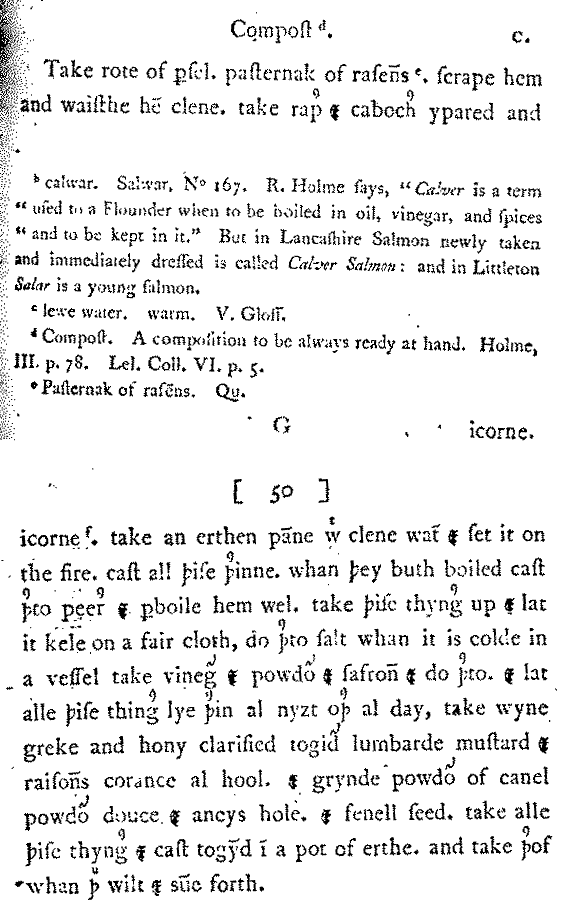
Compost (from Forme of Cury) -
Take
rote of parsel. pasternak of rasenns. scrape hem waisthe hem clene.
take rapes & caboches ypared and icorne. take an erthen panne with
clene water & set it on the fire. cast all þise þerinne. whan þey
buth boiled cast þerto peeres & parboile hem wel. take þise thynges
up & lat it kele on a fair cloth, do þerto salt whan it is colde in a
vessel take vineger & powdour & safroun & do þerto. &
lat alle þise thinges lye þerin al nyzt oþer al day, take wyne greke and
hony clarified togider lumbarde mustard & raisouns corance al hool.
& grynde powdour of canel powdour douce. & aneys hole. &
fenell seed. take alle þise thynges & cast togyder in a pot of
erthe. and take þerof whan þou wilt & serue forth.
Translation (as translated by myself) -
Take
the roots of parsley and parsnip and scrape and wash them clean. Take
turnips and cabbages and cut them up. Take an earthen pan with clean
water and set it on the fire. Cast all of this inside. When they have
boiled, cast pears in and boil them well. Take these things up and let
it cool on a fair cloth, add salt when it is cold. In a vessel take
vinegar and powdour and saffron and let these things lie there in all
night or all day.
Take
greek wine and clarified honey together with mustard and whole raisins
and grind cinnamon powder, powder douce and whole anise and fennel seed.
Take all of these things and cast together in an earthen pot. Take
thereof what you will and serve forth.
Instructions:
1) Wash then peel
all the vegetables and pears. It's important to give them a good wash, in case anything got on the goods before you purchased them!
2) Cut them all into bite-sized pieces, but keep the pears in a separate bowel with a little water and lemon juice to prevent browning.
3) Parboil them
until just tender, then add in the pears. Wait just a few minutes till the pears can absorb the water and become tender themselves.
4) Remove from the water with either your spider or ladle. Place the parboiled veggie/pear mixture on your towel, sprinkle with
salt to cover and allow to cool.
5) Put vegetables in large bowl and add pepper,
saffron, and vinegar. Make sure the veggies have cooled before this step otherwise you may change the flavor of the final dish!
6) Let sit overnight in a cool place, covered. If you have kids or pets that might get into the mess, I recommend putting a lid on your bowl and keeping it in a high/dry place like a closet (it's where I keep mine!).
7) The next
day, put the wine and honey into a saucepan, bring to a boil, and then
simmer for several minutes. The idea here it to combine the flavors, not to damage the honey or wine with scorching so make sure to stir frequently.
8) Let cool and add currants and remaining
spices. Mix well and pour over vegetables. Serve cold.
There are a multitude of items you can add to this dish, that blend well. I'm a fan of carrots and radishes, and they're a similar veggie to the parsnip so they taste great as well. If you want a sweeter pickle, go for more honey and spice, if you like the tart then I recommend cutting back on the fennel and douce.
If you try this, or have tried this before, leave a comment bellow and let me know what you think!
Showing posts with label A/S. Show all posts
Showing posts with label A/S. Show all posts
Friday, January 11, 2013


Friday, September 28, 2012
My Michaelmas A/S Report :)
ID #: 092686CC Name: Christoffer Koch
Category: Food preparation Division: 5; Domestic Arts and Sciences
Compost (from Forme of Cury) -
Take rote of parsel. pasternak of rasenns. scrape hem waisthe hem clene. take rapes & caboches ypared and icorne. take an erthen panne with clene water & set it on the fire. cast all þise þerinne. whan þey buth boiled cast þerto peeres & parboile hem wel. take þise thynges up & lat it kele on a fair cloth, do þerto salt whan it is colde in a vessel take vineger & powdour & safroun & do þerto. & lat alle þise thinges lye þerin al nyzt oþer al day, take wyne greke and hony clarified togider lumbarde mustard & raisouns corance al hool. & grynde powdour of canel powdour douce. & aneys hole. & fenell seed. take alle þise thynges & cast togyder in a pot of erthe. and take þerof whan þou wilt & serue forth.
Translation (as translated by myself) -
Take the parsley and parsnip and scrap and wash them clean. Take turnips and cabbages and cut them up. Take an earthen pan with clean water and set it on the fire. Cast all of this inside. When they have boiled, cast pears in and boil them well. Take these things up and let it cool on a fair cloth, add salt when it is cold. In a vessel take vinegar and powdour and saffron and let these things lie there in all night or all day.
Take greek wine and clarified honey together with mustard and whole raisins and grind cinnamon powder, powder douce and whole anise and fennel seed. Take all of these things and cast together in an earthen pot. Take thereof what you will and serve forth.
Redaction (as done by myself) -
Main Dish Spices
parsley roots (sub. for extra parsips) salt
8 parsnips cinnamon
5 carrots powder douce
12 radishes 1/2 tsp. anise seed
2 turnips 1/2 tsp. fennel seed
1 cabbage pepper
2 pears saffron
1 cup vinegar
1 1/2 cup sweet wine
1/2 cup honey
1 Tbsp. mustard
1/2 cup currants (zante raisins)
Peel vegetables and pears then cut them into bite-sized pieces. Parboil them until just tender.. Remove from water, place on towel, sprinkle with salt, and allow to cool. Put vegetables in large bowl and add pepper, saffron, and vinegar. Let sit several hours in fridge. Then put wine and honey into a saucepan, bring to a boil, and then simmer for several minutes. Let cool and add currants and remaining spices. Mix well and pour over vegetables. Serve cold.
POWDER DOUCE#
3 Tbsp. ground ginger
2 Tbsp. sugar
1 1/2 Tbsp. cinnamon
1 tsp. ground cloves
1 tsp. nutmeg
Source [Le Ménagier de Paris, J. Hinson (trans.)]: HIPPOCRAS. To make powdered hippocras, take a quarter-ounce of very fine cinnamon, hand-picked by tasting it, an ounce of very fine meche ginger and an ounce of grains of paradise, a sixth of an ounce of nutmeg and galingale together, and pound it all together. And when you want to make hippocras, take a good half-ounce or more of this powder and two quarter-ounces of sugar, and mix them together, and a quart of wine as measured in Paris. And note that the powder and the sugar mixed together make “duke’s powder”.
Summary
As this is my first Arts/Sciences entry at this level of category, my documentation for this project will follow closely in structure and formatting as the static form provided on the Trimaris Arts/Science website.
The first section of documentation will be my inspiration for this piece. I am at a disadvantage when it comes to period cooking as far as this section goes, many of the physical arts (fibe,scribal, leatherworking, etc) can offer visual inspirations to create a piece from. As a cook, I am left with the original writing of the manuscript and the translation into modern English as my only sources to use. Thankfully there are many available online for free to use, provided by such sources as Project Gutenberg#.
Next in line is the section on style and and creativity, and more specifically in regards to a discussion of characteristics of style for entry time & place. In making a recreation, I do my very best to stick with what the original recipe called for and following as closely to the original intent the cook had in crafting the dish. I did not stray into the element of creative interpretation when crafting this dish, so I will not be discussing any creative elements about this piece.
Ingredients used is thankfully a straightforward and simple section as the documentation goes for this project. First to be listed will be the ingredients used in period for this dish, followed by a listing of those used in this recreation entry. Finally I will discuss which ingredients I used that would have been different from those used in period, and why I either chose to change those or were forced to change those.
Tools will also be simple and straightforward, similar to the ingredient section. First listed will be the tools used in period, followed by those used for the recreation of this dish. Discussion on tools that I used that would have differed from those in period will be a bit longer than I would like unfortunately, I do not live in an area conducive to live fire cooking and have yet to purchase more period correct tools.
My final section of documentation, technique, will be my largest section written. I will attempt to be as detailed as possible in describing both my technique used in making this dish and those that would have been used in period. I will detail any changes I undertook from the period method of crafting, explaining my substitutions when used and ensuring to describe the proper methods that should have been used but I was unable to.
Inspiration
The biggest tell-tale sign is the size of the pieces being served. The 14th century had not yet had the fork come into being as part of a culinary tradition, so all food items eaten had to be bite sized or able to be eaten with a spoon. The dish has its ingredients prepared in such a way that one can arrange what they would like on a trencher and take bites at their leisure. The piece's need to be a significant size that grasping with one’s hand or removing with a spoon is not a difficulty, but small enough to be bite-sized and not drunk like a soup.
Another sign of this dish is the more exotic elements of the ingredients themselves. Forme of Cury was the recipe roll for Richard the II, a King of England who was known for his extravagance in his court life#. A few items in this dish, while commonplace today, would have been difficult to obtain and required importing of much fresh goods. Windsor Castle, Richard the II’s home for his reign, does not have an overly large area set aside for massive food storage of specialized crops# and give his propensity to be lavish with his feasts# it can be implied that he regularly imported goods or had them purchased. Fennel and Anise seed would have been imported from across the French lines, as much of the centers for their harvesting and growth is the Mediterranean, and zante currant would have been expensive due to its careful cultivation needed to keep viable plants alive.
Likewise, looking at the more common ingredients would also help us in pinpointing a time period and a culture. This is clearly a Autumn/Winter dish owing to the ingredients within, and very English. Parsnip, radish, cabbage and turnip are all foods cultivated within England itself. With winter comes a closing of trade routes due to snow and poor weather, stocks of food would be eaten and what could be grown and harvested locally would have been used with a regularity#. Cabbage, radish and parsnips are also considered winter vegetables, they are harvested during the Autumn#.
Now by looking at this dish, we can see many clear markers of this time period and culture of origin. The pieces for the majority are bite-sized, small enough to be scooped onto a trencher by a serving ladle or spoon but large enough to be a filling bite and not requiring a spoon to eat, which suggests this to be 14th century. The spices inside demonstrate that this was a person of wealth who ate this way, someone who could afford to import certain goods, so we know we are dealing with a Lord from that time period. And finally we have the fact that these are a very winter vegetable selection from England, this leads us to the conclusion that this was a dish served to a wealthy noble at the very least who lived in England for the Winter months in the 14th Century.
Ingredients
Ingredients used in Period:
Ingredients used in this Entry:
Difference in ingredients used and why:
Parsley roots were something I could not require. All of my store-bought options led to dead ends unfortunately, and while my only option was to purchase a plant and use the roots that way I could not afford to purchase that many plants to get the number of roots. Parsnips are from the same family of vegetable#, and a reasonable substitution when the parsley roots are unavailable.
Greek wine is not something I could afford, all of the wines I found costs far too much for me to even consider purchasing for a regional. I went with a sweet red wine, recommended to me by the good people at Whole Foods.
Tools and Equipment
Tools and equipment used in Period:
Tools and equipment used in this Entry:
Difference in tools and equipment used and why:
There are sadly a few differences in tools and equipment from period and this entry, however each is a reasonable substitution for the period element. To start, I do not have access to a real yard to do open fire hearth cooking in, in period they had more than enough access to a real hearth as they were situated inside very much like our stoves would be today. I also do not have the money to afford an earthen pot or pan at this time. I am firmly aware that such a style pot was incredibly common, it is just what would have been used because it was easy to make and mass produce. I have a metal pot, that’s all I really got as far as pots go so I had to make do! As far as the glass dish goes, I have cats and could not let the cloth sit out. I had to put the cloth in the glass dish and put up high in my closet to avoid animal influence!
Technique
Technique used in Period:
The Master Chef of the kitchen would have assigned several people different roles and would have overseen the cooking of all the projects in the kitchen. One person’s job would have been to manage the hearth fire, keeping it to temperature and changing out coals/creating new coals as needed. Another’s job would have been peeling and slicing of vegetables and their upkeep and care. Anoter would have been in charge of the herbs and spices, making the blends and preparing them for use in the kitchen.
Technique used in this Entry:
I started with washing all my utensils and getting my dishes set. I filled my pot with water, and started the water to a slow boil. While it slowly increased in temperature, I peeled and cut my vegetables and pear. I dropped them into the pot and parboiled them till just tender. I removed the pieces from the water using the ladle, placed them on a dry towel, sprinkled with salt and allow to cool. When cooled, I put the vegetables in bowl and added the pepper, saffron, and vinegar. I let it sit several hours in the fridge because I have pets in a small place and a place to hide it to chill overnight/all day is next to impossible. When finally chilled I put the wine and honey into a saucepan, brought it up to a rolling boil, and then simmered it down for 10 minutes. I let cool then added currants and remaining spices.I mixed the new sauce up and poured over vegetables.
Difference in technique used and why:
The biggest thing that’s a difference is a lack of my kitchen staff. I would have had a legion of helpers, people who had specific tasks whose sole job entailed peeling/saucing/heat tending. Without those people, I would be forced to do everything myself which is a big change from period.
Since I did not have an active heat source to use, I did not have to maintain a fire and keep the coals at a specific temperature. I did not have to constantly create more coals, nor did I have to to transfer those coals from one hearth location to another. I also did not have to dispose of the remaining ash when complete.
Due to a lack of pet-free location that would also be cool to keep the vegetables overnight/all day, I ended up using the fridge to cool the dish down to the right temperature for the sauce. Normally the dish would have been simply kept in a cooler and isolated are to sit, but lacking that in my tiny place I had to use what I had available.
Bibliography
Category: Food preparation Division: 5; Domestic Arts and Sciences
Compost - A Recreation from Forme of Cury
Originating
from England, the cookery text this recipe hails from around 1390 A.D.
is entitled Forme of Cury. This roll of recipes were compiled by the
Master-Chefs# of King Robert the II, and thus is a listing of foods
cooked for the royalty and nobility of England.
Compost (from Forme of Cury) -
Take rote of parsel. pasternak of rasenns. scrape hem waisthe hem clene. take rapes & caboches ypared and icorne. take an erthen panne with clene water & set it on the fire. cast all þise þerinne. whan þey buth boiled cast þerto peeres & parboile hem wel. take þise thynges up & lat it kele on a fair cloth, do þerto salt whan it is colde in a vessel take vineger & powdour & safroun & do þerto. & lat alle þise thinges lye þerin al nyzt oþer al day, take wyne greke and hony clarified togider lumbarde mustard & raisouns corance al hool. & grynde powdour of canel powdour douce. & aneys hole. & fenell seed. take alle þise thynges & cast togyder in a pot of erthe. and take þerof whan þou wilt & serue forth.
Translation (as translated by myself) -
Take the parsley and parsnip and scrap and wash them clean. Take turnips and cabbages and cut them up. Take an earthen pan with clean water and set it on the fire. Cast all of this inside. When they have boiled, cast pears in and boil them well. Take these things up and let it cool on a fair cloth, add salt when it is cold. In a vessel take vinegar and powdour and saffron and let these things lie there in all night or all day.
Take greek wine and clarified honey together with mustard and whole raisins and grind cinnamon powder, powder douce and whole anise and fennel seed. Take all of these things and cast together in an earthen pot. Take thereof what you will and serve forth.
Redaction (as done by myself) -
Main Dish Spices
parsley roots (sub. for extra parsips) salt
8 parsnips cinnamon
5 carrots powder douce
12 radishes 1/2 tsp. anise seed
2 turnips 1/2 tsp. fennel seed
1 cabbage pepper
2 pears saffron
1 cup vinegar
1 1/2 cup sweet wine
1/2 cup honey
1 Tbsp. mustard
1/2 cup currants (zante raisins)
Peel vegetables and pears then cut them into bite-sized pieces. Parboil them until just tender.. Remove from water, place on towel, sprinkle with salt, and allow to cool. Put vegetables in large bowl and add pepper, saffron, and vinegar. Let sit several hours in fridge. Then put wine and honey into a saucepan, bring to a boil, and then simmer for several minutes. Let cool and add currants and remaining spices. Mix well and pour over vegetables. Serve cold.
POWDER DOUCE#
3 Tbsp. ground ginger
2 Tbsp. sugar
1 1/2 Tbsp. cinnamon
1 tsp. ground cloves
1 tsp. nutmeg
Source [Le Ménagier de Paris, J. Hinson (trans.)]: HIPPOCRAS. To make powdered hippocras, take a quarter-ounce of very fine cinnamon, hand-picked by tasting it, an ounce of very fine meche ginger and an ounce of grains of paradise, a sixth of an ounce of nutmeg and galingale together, and pound it all together. And when you want to make hippocras, take a good half-ounce or more of this powder and two quarter-ounces of sugar, and mix them together, and a quart of wine as measured in Paris. And note that the powder and the sugar mixed together make “duke’s powder”.
Summary
As this is my first Arts/Sciences entry at this level of category, my documentation for this project will follow closely in structure and formatting as the static form provided on the Trimaris Arts/Science website.
The first section of documentation will be my inspiration for this piece. I am at a disadvantage when it comes to period cooking as far as this section goes, many of the physical arts (fibe,scribal, leatherworking, etc) can offer visual inspirations to create a piece from. As a cook, I am left with the original writing of the manuscript and the translation into modern English as my only sources to use. Thankfully there are many available online for free to use, provided by such sources as Project Gutenberg#.
Next in line is the section on style and and creativity, and more specifically in regards to a discussion of characteristics of style for entry time & place. In making a recreation, I do my very best to stick with what the original recipe called for and following as closely to the original intent the cook had in crafting the dish. I did not stray into the element of creative interpretation when crafting this dish, so I will not be discussing any creative elements about this piece.
Ingredients used is thankfully a straightforward and simple section as the documentation goes for this project. First to be listed will be the ingredients used in period for this dish, followed by a listing of those used in this recreation entry. Finally I will discuss which ingredients I used that would have been different from those used in period, and why I either chose to change those or were forced to change those.
Tools will also be simple and straightforward, similar to the ingredient section. First listed will be the tools used in period, followed by those used for the recreation of this dish. Discussion on tools that I used that would have differed from those in period will be a bit longer than I would like unfortunately, I do not live in an area conducive to live fire cooking and have yet to purchase more period correct tools.
My final section of documentation, technique, will be my largest section written. I will attempt to be as detailed as possible in describing both my technique used in making this dish and those that would have been used in period. I will detail any changes I undertook from the period method of crafting, explaining my substitutions when used and ensuring to describe the proper methods that should have been used but I was unable to.
Inspiration
As
I am left without a visual aide (like calligraphy) or a museum piece
(like armor) to use as a source of inspiration, I am left with just the
original recipe. This copy presented above is a scan of the Samuel Pegge
edition, which is available online for free#. The Samuel Pegge edition
is an excellent copy, the author made no effort to truly translate the
original middle english but instead just copied from the original
manuscript. I am also provided online another SCA member who has
translated this recipe before and offered their own personal redaction
for use online as a secondary resource#, as well as a text released by
The Metropolitan Museum of Art which covers this dish as well#
Style and Creativity
When
it comes to style and creativity in helps of identifying a specific
time period, food is a bit more of a challenge than your average art.
Food variations tended to shift regularly, when a recipe would travel
across a mountain into a new country suddenly it would develop a new
twist of spice or lose an ingredient as it was no longer available on a
regular basis#. There are several factor that allow us to highlight and
select this dish as from the 14th Century, and the trained observer will
be able to see these traces within the dish.
The biggest tell-tale sign is the size of the pieces being served. The 14th century had not yet had the fork come into being as part of a culinary tradition, so all food items eaten had to be bite sized or able to be eaten with a spoon. The dish has its ingredients prepared in such a way that one can arrange what they would like on a trencher and take bites at their leisure. The piece's need to be a significant size that grasping with one’s hand or removing with a spoon is not a difficulty, but small enough to be bite-sized and not drunk like a soup.
Another sign of this dish is the more exotic elements of the ingredients themselves. Forme of Cury was the recipe roll for Richard the II, a King of England who was known for his extravagance in his court life#. A few items in this dish, while commonplace today, would have been difficult to obtain and required importing of much fresh goods. Windsor Castle, Richard the II’s home for his reign, does not have an overly large area set aside for massive food storage of specialized crops# and give his propensity to be lavish with his feasts# it can be implied that he regularly imported goods or had them purchased. Fennel and Anise seed would have been imported from across the French lines, as much of the centers for their harvesting and growth is the Mediterranean, and zante currant would have been expensive due to its careful cultivation needed to keep viable plants alive.
Likewise, looking at the more common ingredients would also help us in pinpointing a time period and a culture. This is clearly a Autumn/Winter dish owing to the ingredients within, and very English. Parsnip, radish, cabbage and turnip are all foods cultivated within England itself. With winter comes a closing of trade routes due to snow and poor weather, stocks of food would be eaten and what could be grown and harvested locally would have been used with a regularity#. Cabbage, radish and parsnips are also considered winter vegetables, they are harvested during the Autumn#.
Now by looking at this dish, we can see many clear markers of this time period and culture of origin. The pieces for the majority are bite-sized, small enough to be scooped onto a trencher by a serving ladle or spoon but large enough to be a filling bite and not requiring a spoon to eat, which suggests this to be 14th century. The spices inside demonstrate that this was a person of wealth who ate this way, someone who could afford to import certain goods, so we know we are dealing with a Lord from that time period. And finally we have the fact that these are a very winter vegetable selection from England, this leads us to the conclusion that this was a dish served to a wealthy noble at the very least who lived in England for the Winter months in the 14th Century.
Ingredients
Ingredients used in Period:
- Parsley roots
- Parsnips
- Carrots
- Radishes
- Turnips
- Cabbage
- Pear
- Vinegar
- Greek wine
- Honey
- Mustard
- Zante currants
- Cinnamon
- Powder douce
- Anise seed
- Fennel seed
- Salt
- Saffron
- Pepper
Ingredients used in this Entry:
- Parsnips
- Carrots
- Radishes
- Turnips
- Cabbage
- Pear
- Vinegar
- Red Wine
- Honey
- Mustard
- Zante currants
- Cinnamon
- Powder douce
- Anise seed
- Fennel seed
- Salt
- Saffron
- Pepper
Difference in ingredients used and why:
When
making a recreation of a dish, I strive to recreate and replicate as
much as possible. I do my best not to stray from the source material
used unless necessary. I only remove certain foods due to unavailability
in purchase or inability to recreate when a recipe is not
available/food item is not sold in America. Sadly I had to make some
substitutions and changes, but I feel it still does the entry justice.
Parsley roots were something I could not require. All of my store-bought options led to dead ends unfortunately, and while my only option was to purchase a plant and use the roots that way I could not afford to purchase that many plants to get the number of roots. Parsnips are from the same family of vegetable#, and a reasonable substitution when the parsley roots are unavailable.
Greek wine is not something I could afford, all of the wines I found costs far too much for me to even consider purchasing for a regional. I went with a sweet red wine, recommended to me by the good people at Whole Foods.
Tools and Equipment
Tools and equipment used in Period:
- Knife
- Hearth
- Earthen Pot
- Ladle
- Mixing bowl
- Mortor pestle
- Earthen pan
- Cloth
Tools and equipment used in this Entry:
- Knife
- Stove
- Metal pot
- Ladle
- Mixing bowl
- Mortor pestle
- Cloth
- Glass dish
Difference in tools and equipment used and why:
There are sadly a few differences in tools and equipment from period and this entry, however each is a reasonable substitution for the period element. To start, I do not have access to a real yard to do open fire hearth cooking in, in period they had more than enough access to a real hearth as they were situated inside very much like our stoves would be today. I also do not have the money to afford an earthen pot or pan at this time. I am firmly aware that such a style pot was incredibly common, it is just what would have been used because it was easy to make and mass produce. I have a metal pot, that’s all I really got as far as pots go so I had to make do! As far as the glass dish goes, I have cats and could not let the cloth sit out. I had to put the cloth in the glass dish and put up high in my closet to avoid animal influence!
Technique
Technique used in Period:
The Master Chef of the kitchen would have assigned several people different roles and would have overseen the cooking of all the projects in the kitchen. One person’s job would have been to manage the hearth fire, keeping it to temperature and changing out coals/creating new coals as needed. Another’s job would have been peeling and slicing of vegetables and their upkeep and care. Anoter would have been in charge of the herbs and spices, making the blends and preparing them for use in the kitchen.
With
all these people in place, the meal would have come together. The
vegetables would have been peeled and sliced, then boiled. when finished
the spicer would have added the needed spices then give it to someone
to set aside for a day or night. The next day it would have been taken
up by the cooking staff responsible for sauces, and the remaining steps
(blending and adding the sauces) would have been completed. It would
have then been set aside and served at whatever meal it was requested
for.
Technique used in this Entry:
I started with washing all my utensils and getting my dishes set. I filled my pot with water, and started the water to a slow boil. While it slowly increased in temperature, I peeled and cut my vegetables and pear. I dropped them into the pot and parboiled them till just tender. I removed the pieces from the water using the ladle, placed them on a dry towel, sprinkled with salt and allow to cool. When cooled, I put the vegetables in bowl and added the pepper, saffron, and vinegar. I let it sit several hours in the fridge because I have pets in a small place and a place to hide it to chill overnight/all day is next to impossible. When finally chilled I put the wine and honey into a saucepan, brought it up to a rolling boil, and then simmered it down for 10 minutes. I let cool then added currants and remaining spices.I mixed the new sauce up and poured over vegetables.
Difference in technique used and why:
The biggest thing that’s a difference is a lack of my kitchen staff. I would have had a legion of helpers, people who had specific tasks whose sole job entailed peeling/saucing/heat tending. Without those people, I would be forced to do everything myself which is a big change from period.
Since I did not have an active heat source to use, I did not have to maintain a fire and keep the coals at a specific temperature. I did not have to constantly create more coals, nor did I have to to transfer those coals from one hearth location to another. I also did not have to dispose of the remaining ash when complete.
Due to a lack of pet-free location that would also be cool to keep the vegetables overnight/all day, I ended up using the fridge to cool the dish down to the right temperature for the sauce. Normally the dish would have been simply kept in a cooler and isolated are to sit, but lacking that in my tiny place I had to use what I had available.
Bibliography
- To the Kings Taste by Lorna J. Sass
- A Study of Cooking Task, Methods, and Equipment in the Renaissance Kitchen by Chris P. Alder-France (Dame Katja Davidova orlova Khazarina), Aethelmearc Academy, Stormspot, June 19th @004, Originally presented Janurary 20th, 2002 in Colorado Springs
- Forme of Cury, Samuel Pegge edition
- Salt: A World History by mark Kurlanksy published 2002
- The Medieval Kitchen by Odlile Redon and Francoie Sabbont and Silvano Serventi published 1998
- Fourteenth century England, Volume 1 by Nigel Sault, published 2000
- http://recipes.medievalcookery.com/
Monday, August 20, 2012
Class handouts Pt. 2
This is the handout for the second class I taught this year at Res Festivus. This one I put together last minute to fill a hole in the schedule, I was pretty happy with it and it was well attended! I ad a few people take my email address to ask further questions, and ended up inspiring one of my friends to enter A/S for the first time!
* * *
So, what exactly did they eat back then?
. Some food eaten in the Middle Ages is similar to the food eaten today all across Europe. People ate what the land provided, what livestock could be raised and what spices could be added.
. Food that could be kept for long term was used regularly, such as grains or certain types of vegetables. Meat was of course important to the diet, stored with a variety of methods if not prepared fresh. Since most major towns were close enough to a major waterway for trade, fish and other water-based life were also an important staple. When food would become scarce, wild plants and herbs would be used to help supplement diets.
. Spices, herbs and other types of supplements to the main dish were added regularly. Salt, garlic and sugar were important staples of the diet (though not the only ones ever used!)
Medieval Food, why was it so heavily spiced?!
. In the Middle Ages, we did not have medicine as it is known today. You wouldn’t take vitamin pills to get Vitamin C, or drink cough syrup to help with a cold. Yet the same problems persist, sickness and a lack of well health. So the people of the Middle Ages found ways to get the health benefits needed!
. Herbal knowledge, the basics of what plants and herbs/spices provided what, was common knowledge for the people of the Middle Ages. Chefs for noble households would be more than simply well-versed, and would incorporate health benefitting items into each dish.
. Certain spices, herbs and foods were known to have health benefits. Eating these items or drinking them in teas would provide the person with the beneficial bonuses.
We clearly don’t eat like that anymore, right?
. So not true! Many dishes and foods they ate in the Middle Ages we continue to eat today.
. The types of meats available haven’t changed, and many of the spices we still use today were available for the chefs as well. We can mass produce most of the vegetables and fruits nowadays, but they were available to our ancestors just as frequently as ours.
. Just like they did, we use a variety of spices for our meats and foods to change the flavor and tastes. Would you be happy with eating plain/boring pork chops for 5 days straight?
. Many whole dishes we eat today hail from the Middle Ages! The following food dishes are all period documented and eaten in that day and age as well as today:
Some useful recipes.
. Tostees Dorees
Basically French Toast, an old idea that turns up in numerous cookery texts. This is how the
Viandierlviii (#198) describes them. The translation is Scully's:
Pour faire Tostees dorees, prenez du pain blanc dur et le trenchiez par tostees quarees et les
rostir ung pou sur le grail; et avoir moyeulx d'oeufz batuz et les envelopez tres bien dedans
iceulx moyeulx; et avoir de bon sain chault et les dorer dedans sur le feu tant qu'elles soient
belles et puis les oster dedans la paelle et mettez es platz, et du succre dessus.
To make glazed toast, slice hard white bread into squares for toast, and roast them lightly on
the grill, and coat them completely with beaten egg yolks; get good hot grease and glaze them
in it on the fire until they are properly glazed; then take them out of the pan and put them on
plates, with sugar over top.
6 slices dry white bread
6 egg yolks (or 2 whole eggs)
oil or butter
sugar
Remove the crust from the bread slices and, if they are not sufficiently dry, lightly toast them before the fire. Beat the egg yolks. Heat a little oil or butter in a pan, soak the toast slices in the egg and fry them golden brown on both sides. Serve warm, with sugar sprinkled over the top. This can also be served with savoury soups, leaving out the sugar.
. Funnelcakes
Rumpoldtlvii describes a tasty kind of fritter that has an additional benefit: Its preparation is showy and entertaining.
Mach ein Teig mit guter Milch / schlag drei oder vier Eyer darein / und ruer jn wol glat
an / mach Loecher durch ein Hafen / der nicht groß ist / geuß den Teig darein / und halt
ein Teller unten auff den Boden / daß der Teig nicht heraus rinnet / daß du es kanst
kreutzweiß in heisse Butter eynziehen / zeuchs nicht zu dick eyn / daß es kann außbacken /
bestraew es mit Zucker / unnd gibs kalt oder warm auff ein Tisch / so ist es ein gut
Strauben Gebackens.
Make a batter of good milk, break three or four eggs into it and stir it until it is nice and
smooth. Make holes into a pot that is not too large, pour the batter into it and hold a plate
against the bottom so it does not run out. You can pour it crosswise into hot butter. Do not
pour it on too thick so that it can bake. Sprinkle it with sugar and serve it warm or cold.
These are good fritters.
1 1/2 cups milk
3 eggs
1-2 cups flour
salt
Beat the eggs with the milk and a pinch of salt until combined. Stir in flour by the tablespoonful
until a thick but still runny batter results. Heat plenty of oil or fat in a pan and pour the batter into it
in a thin stream. You can make circles or figures if you like. Once the fritters begin to brown and
harden, carefully turn them over with two spatulas or spoons. Drain on paper towels and serve
warm, dusted with sugar.
. Chicken Boiled with Herbs
While most chicken recipes tend to involve either pastries or complex cooking methods, the early fourteenth-century Omnia Cibariaxiv (II.5) preserves instructions for a simple mode of preparation:
Pullus in aqua dequoquendus hoc modo preparatur: accipitur pullus integer, et in potto
dequoquitur cum saluia, ysopo, aut petrosillo non inciso, per horam. Post, imponitur de
uino albo uel agresta, et sic administratur.
Chicken to be cooked in water is prepared thus: You take a whole chicken and cook it in a pot
with sage, hyssop or parsley, not cut up, for an hour. Afterwards, put in white wine or
verjuice and thus serve it.
1 chicken
1 bunch parsley
sage
hyssop
salt
white wine or verjuice
Bring lightly salted water to a boil in a large pot and put in the chicken together with the herbs.
Gently cook till done. It is better to overcook than undercook, and if you are worried about the bird
falling apart, you can tie it up with string before throwing it in. This will also make removing it
easier. A dash of vinegar or wine added before serving lends it a bit of zest. If you wish, you can
also quickly brown the cooked chicken over the fire before it goes on the table. Parboiling birds
before roasting was a common thing to do.
Resources used:
. The Medieval Kitchen: recipes from France and Italy by Odile Redon, Francoise Sabban, and Silvano Serventi
. Plain Fare: A Period Camp Cookbook; A collection of simple, documented recipes for cooking in camp from the Kingdom of Drachenwald by Giano Balestriere (Volker Bach)
. The Forme of Cury by Samuel Pegge
* * *
Feast with the King
Why they ate certain foods at feasts, what they ate at feasts, and how we haven’t changed!
A class written and taught by Christoffer Koch
So, what exactly did they eat back then?
. Some food eaten in the Middle Ages is similar to the food eaten today all across Europe. People ate what the land provided, what livestock could be raised and what spices could be added.
. Food that could be kept for long term was used regularly, such as grains or certain types of vegetables. Meat was of course important to the diet, stored with a variety of methods if not prepared fresh. Since most major towns were close enough to a major waterway for trade, fish and other water-based life were also an important staple. When food would become scarce, wild plants and herbs would be used to help supplement diets.
. Spices, herbs and other types of supplements to the main dish were added regularly. Salt, garlic and sugar were important staples of the diet (though not the only ones ever used!)
Medieval Food, why was it so heavily spiced?!
. In the Middle Ages, we did not have medicine as it is known today. You wouldn’t take vitamin pills to get Vitamin C, or drink cough syrup to help with a cold. Yet the same problems persist, sickness and a lack of well health. So the people of the Middle Ages found ways to get the health benefits needed!
. Herbal knowledge, the basics of what plants and herbs/spices provided what, was common knowledge for the people of the Middle Ages. Chefs for noble households would be more than simply well-versed, and would incorporate health benefitting items into each dish.
. Certain spices, herbs and foods were known to have health benefits. Eating these items or drinking them in teas would provide the person with the beneficial bonuses.
We clearly don’t eat like that anymore, right?
. So not true! Many dishes and foods they ate in the Middle Ages we continue to eat today.
. The types of meats available haven’t changed, and many of the spices we still use today were available for the chefs as well. We can mass produce most of the vegetables and fruits nowadays, but they were available to our ancestors just as frequently as ours.
. Just like they did, we use a variety of spices for our meats and foods to change the flavor and tastes. Would you be happy with eating plain/boring pork chops for 5 days straight?
. Many whole dishes we eat today hail from the Middle Ages! The following food dishes are all period documented and eaten in that day and age as well as today:
. Funnel Cake
. Scrambled Eggs
. Chicken Noodle Soup
. Mac ‘n’ Cheese
. Hot Dogs
. Cheesecake
. Shortbread cookies
. Roasted Chicken
. Apple Pie
. Spaghetti and Meatballs
. Honey Mustard
And many more...
Some useful recipes.
. Tostees Dorees
Basically French Toast, an old idea that turns up in numerous cookery texts. This is how the
Viandierlviii (#198) describes them. The translation is Scully's:
Pour faire Tostees dorees, prenez du pain blanc dur et le trenchiez par tostees quarees et les
rostir ung pou sur le grail; et avoir moyeulx d'oeufz batuz et les envelopez tres bien dedans
iceulx moyeulx; et avoir de bon sain chault et les dorer dedans sur le feu tant qu'elles soient
belles et puis les oster dedans la paelle et mettez es platz, et du succre dessus.
To make glazed toast, slice hard white bread into squares for toast, and roast them lightly on
the grill, and coat them completely with beaten egg yolks; get good hot grease and glaze them
in it on the fire until they are properly glazed; then take them out of the pan and put them on
plates, with sugar over top.
6 slices dry white bread
6 egg yolks (or 2 whole eggs)
oil or butter
sugar
Remove the crust from the bread slices and, if they are not sufficiently dry, lightly toast them before the fire. Beat the egg yolks. Heat a little oil or butter in a pan, soak the toast slices in the egg and fry them golden brown on both sides. Serve warm, with sugar sprinkled over the top. This can also be served with savoury soups, leaving out the sugar.
. Funnelcakes
Rumpoldtlvii describes a tasty kind of fritter that has an additional benefit: Its preparation is showy and entertaining.
Mach ein Teig mit guter Milch / schlag drei oder vier Eyer darein / und ruer jn wol glat
an / mach Loecher durch ein Hafen / der nicht groß ist / geuß den Teig darein / und halt
ein Teller unten auff den Boden / daß der Teig nicht heraus rinnet / daß du es kanst
kreutzweiß in heisse Butter eynziehen / zeuchs nicht zu dick eyn / daß es kann außbacken /
bestraew es mit Zucker / unnd gibs kalt oder warm auff ein Tisch / so ist es ein gut
Strauben Gebackens.
Make a batter of good milk, break three or four eggs into it and stir it until it is nice and
smooth. Make holes into a pot that is not too large, pour the batter into it and hold a plate
against the bottom so it does not run out. You can pour it crosswise into hot butter. Do not
pour it on too thick so that it can bake. Sprinkle it with sugar and serve it warm or cold.
These are good fritters.
1 1/2 cups milk
3 eggs
1-2 cups flour
salt
Beat the eggs with the milk and a pinch of salt until combined. Stir in flour by the tablespoonful
until a thick but still runny batter results. Heat plenty of oil or fat in a pan and pour the batter into it
in a thin stream. You can make circles or figures if you like. Once the fritters begin to brown and
harden, carefully turn them over with two spatulas or spoons. Drain on paper towels and serve
warm, dusted with sugar.
. Chicken Boiled with Herbs
While most chicken recipes tend to involve either pastries or complex cooking methods, the early fourteenth-century Omnia Cibariaxiv (II.5) preserves instructions for a simple mode of preparation:
Pullus in aqua dequoquendus hoc modo preparatur: accipitur pullus integer, et in potto
dequoquitur cum saluia, ysopo, aut petrosillo non inciso, per horam. Post, imponitur de
uino albo uel agresta, et sic administratur.
Chicken to be cooked in water is prepared thus: You take a whole chicken and cook it in a pot
with sage, hyssop or parsley, not cut up, for an hour. Afterwards, put in white wine or
verjuice and thus serve it.
1 chicken
1 bunch parsley
sage
hyssop
salt
white wine or verjuice
Bring lightly salted water to a boil in a large pot and put in the chicken together with the herbs.
Gently cook till done. It is better to overcook than undercook, and if you are worried about the bird
falling apart, you can tie it up with string before throwing it in. This will also make removing it
easier. A dash of vinegar or wine added before serving lends it a bit of zest. If you wish, you can
also quickly brown the cooked chicken over the fire before it goes on the table. Parboiling birds
before roasting was a common thing to do.
Resources used:
. The Medieval Kitchen: recipes from France and Italy by Odile Redon, Francoise Sabban, and Silvano Serventi
. Plain Fare: A Period Camp Cookbook; A collection of simple, documented recipes for cooking in camp from the Kingdom of Drachenwald by Giano Balestriere (Volker Bach)
. The Forme of Cury by Samuel Pegge
Subscribe to:
Posts (Atom)