Showing posts with label English. Show all posts

Tuesday, March 23, 2021

SCA Dish: Waffres

 Waffres


    This week I wanted to make something more breakfast themed and more savory, as requested by my partner who very much enjoyed the pears but they were quite sweet. Looking through the manuscript I found this delightful recipe, and thankfully found many other sources online who had also attempted such. This is Waffres, from “Two Fifteenth-Century Cookery-Books” and the original recipe is as follows:

.xxiiij. Waffres. Take þe Wombe of A luce, & seþe here wyl, & do it on a morter, & tender cheese þer-to, grynde hem y-fere; þan take flowre an whyte of Eyroun & bete to-gedere, þen take Sugre an pouder of Gyngere, & do al to-gerderys, & loke þat þin Eyroun ben hote, & ley þer-on of þin paste, & þan make þin waffrys, & serue yn.

    After consulting my own middle English notes for translations, comparing it to other translations found online and using google to look up some unfamiliar terms, I found the following to be the best translation into modern English for this dish:

Wafers. Take the [belly flesh of a pike], and boil it well, and mash it in a mortar, and add soft cheese, grind them well; then take flour and egg whites and beat it together, then take sugar and ground ginger, and mix all together, and see that the [dough is room temperature], and make a [thin batter], and make the wafers, and serve.

    This recipe....oooh boy. There’s a lot going on here to start with, but first I wanna reference the missing ingredients. In every period recipe we have from a documented source, we find missing ingredients. Many of these texts were written as shorthand for what should be in each dish, or what the particular noble liked in their meat pie or how to cut a food a certain way to be the most appealing. Anyone who had access to these texts therefore had YEARS of training, having a basic understanding of how to control heat or cook various items or even when to add water or other ingredients. Since writing down these manuscripts was a significant effort before the invention (and later widespread use of) the printing press, many details would be dropped. When translating this to a modern recipe format, we therefore have to take into account the missing items and add them in to finish the item in question.

    In this recipe alone I feel, with my experience in cooking fried foods, there are two key missing items. First is water, if this is going to be any kind of thin batter or dough for a fried or baked food there will need to be water added to make the dough work. The finished dough is not thin enough to be worked well in any format, too thick to make anything resembling a wafer and will not cook properly with its density, so water is needed to thin it out and help stretch the dough into something more usable for whatever form it will take. Secondly is the salt, because salt is in everything. Salt is key in various baking projects to help enhance and fortify the flavors in the dough, so adding a bit of salt will be needed (despite it not being mentioned). Having taken into account these two items, I can begin with the recipe in earnest.

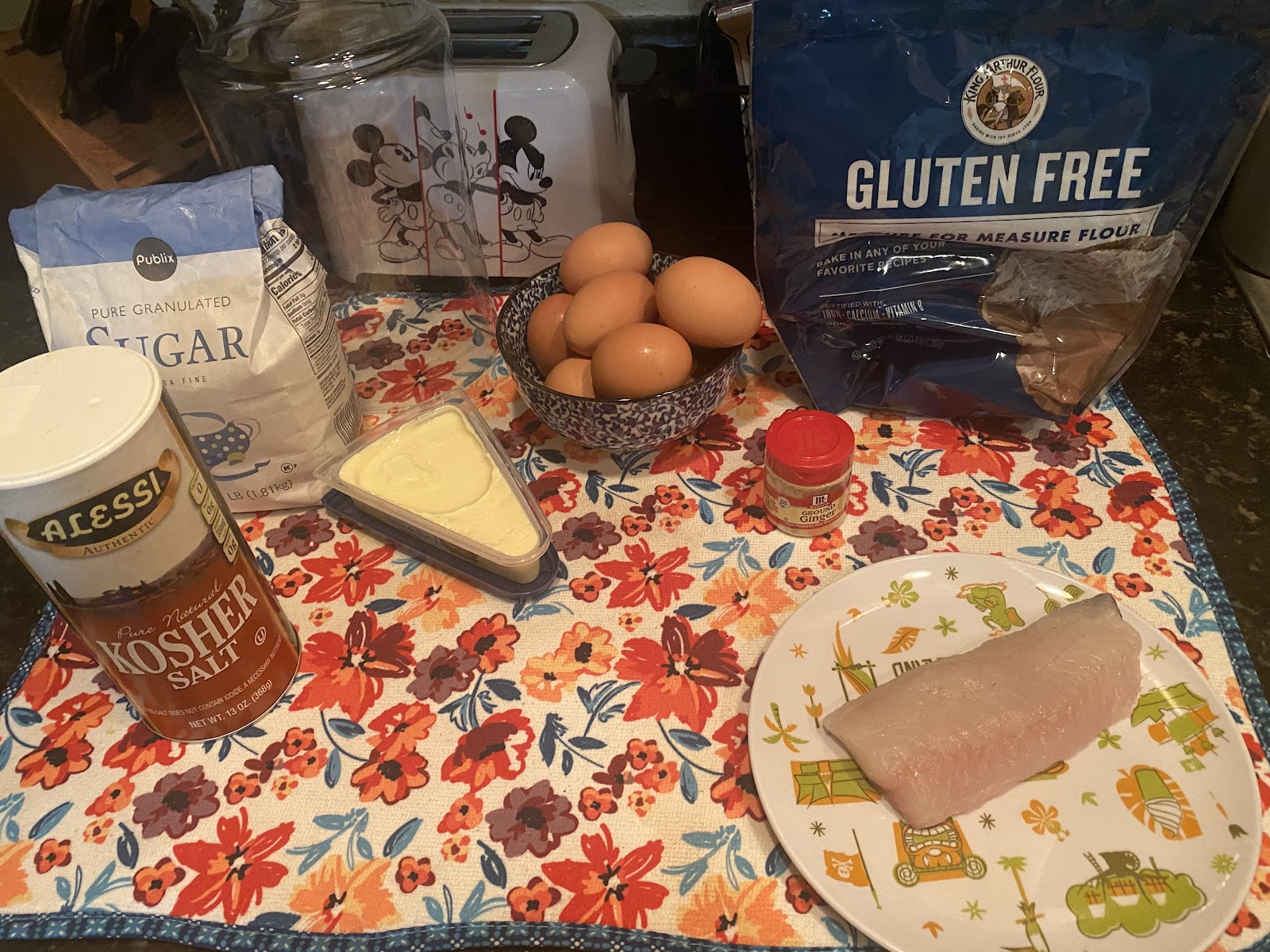
    While I do strive to recreate this dish as period accurate as possible, I do have to take into account a few modern changes. Considering my partner and her dietary restrictions, as well as the restrictions of a few of my friends (aka test subjects), I chose to use gluten-free flour instead of a standard flour. I use King Arthur's Gluten-Free Measure for Measure for all my gluten-free cooking, it has the xanthan gum pre-mixed in it so it's a great recreation of whole wheat flour. I also switched to walleye fish instead of pike, sadly pike isn’t readily available here in Florida in various retail stores but I was able to get my hands on walleye instead. Walleye is another freshwater fish that many resources state is similar in texture to pike, and a good substitute for pike in dishes. When it comes to cheese, they specify a tender cheese but not list an exact type. Considering other recipe’s around this one list various ingredients that can be traced back to/are imported from France, I chose to use brie because it's a favorite soft cheese of mine and comes from a similar region of France that other items would have been imported in period. What we consume today as brie is going to be different than the period forms of cheese that would later become brie as we know it, but this is a close proximity I feel.

    While going through with this translation and redaction, I came upon a stumbling block in the term “womb of a pike”. There are several translations which could have womb describe either the organs of the fish, the fish roe itself or perhaps the belly cut of the fish fillet as the section of fish to be used. I discussed this with several cooking friends as well as various SCA cooks online, and had some great discussions and contrasting opinions on this exact translation. But in the end I decided to go with the fish belly cut of a fillet, for a number of reasons. First, in this manuscript itself (and in other cooking manuscripts from around this time) the internal organs are often referred to using their own terms like offal. Because they choose to use the term wombe instead of awful, I feel like we can safely rule out that as an option. In regards to it possibly being the roe, or eggs, of the fish I again have to disagree. While it’s entirely possible that fish roe could be used in such a way, and honestly that would be super tasty to try, I have to say that for this recipe it’s highly unlikely to have been used. Pike spawn starting in late February at the earliest and at their height in late March to mid-April. This would put this dish pointedly as a springtime dish only, not only that but would make it decidedly NOT a Lenten dish. In this manuscript, and in others from around its time, they make it a point to state if a dish is available or should be consumed only during a certain period of time or is a Lenten dish. I am aware that roe would have only been available during Lent due to the spawning time of pike, which normally wouldn’t have been an issue since fish could be eaten during Lent, but this dish specifically mentions both eggs and cheese which would not have been an approved Lenten food during this time.

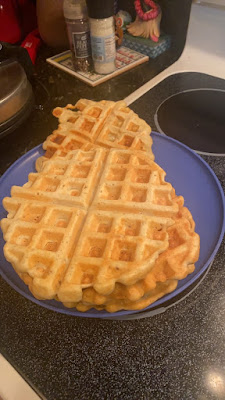
    Another point I have had extensive discussion with my Laurel and Apprentice brother on is the consistency and type of item being made by this recipe. My Laurel feels that the translation of the dish and description leads this to be a thinner/crispier finished product than the thicker waffle version I made. We have gone back and forth on this for a bit, but I am still confident that this would not have been a thin and crispy item but a baked good with at least a little density and weight to it. For starters, nowhere else in this particular manuscript can I locate any other recipes for wafers to compare it to. Without a contrasting recipe to compare it's hard for me to pick one side or the other, except that the original recipe did say to make a thin wafer. The ingredients in this item are particularly difficult to translate over a thin surface, the fish and soft cheese would lose much of their flavor if further diluted by water to thin out the batter to be thinner or to have it pressed so tightly to be thin and crispy. Period wafer irons of the time do create a thin wafer, but by examining various recovered objects from digital sources there is still a significant gap in between the two irons to allow for two separate images to be transferred onto the wafer and not distort the other. Further testing will be needed to better know exactly how thin a wafer should be, but this particular one lends itself to me to be thicker to allow for the denser ingredients to mix evenly and to allow the two iron images enough density to have zero bleed-over. This is just my opinion on the topic given the information available, and I would love to hear others opinions on the topic and discuss this further!

    With all that said, this is my redacted recipe and steps taken to make this dish. Feel free to make this along at home, and let me know how you enjoy it! I think the finished waffles are amazing when topped with honey (for a sweeter dish) or a nice hot mustard (for a more savory bite).


Ingredients I used:

6 Large Eggs, using the whites only

1/2lb Walleye belly cut fillet

1/2 cup Brie

1/4 cup White Sugar

4 tbsp Ground Ginger

1tsp Salt

1 1/2 cup Cold Water


  1. Plug in your waffle maker and heat it up, getting it ready. While that's heating, take a large pot and fill with cold water. Set to boil, and put a strainer in the sink for later use.

  2. While the water is heating, take your fish and wash clean. Cut into smaller pieces to allow for an easier time shredding down. Set aside fish, and combine your dry ingredients into a mixing bowl and set aside. Crack your eggs and separate your yokes, keeping the whites in a small side bowl and set aside.

  3. As the water begins to boil, put the fish in. Boil for just 5-7 minutes, the flesh should be fully white and flaking when cooked. Once finished cooking, gently poor the water through the strainer to remove all the water and catch all the fish. 

  4. In a small mixing bowl add the fish, brie and 6 egg whites. Blend till fully mixed in and one thick consistent batter. 

  5. Add in your dry ingredients and then water. Mix thoroughly until a smooth and consistent batter. If too thick, carefully d 1/4 cup of water at a time until you have a smooth but thick batter.

  6. Spray your waffle iron with cooking oil spray, and slowly scoop 1/2 cup of batter onto the iron. This batter is very thick and will not flow well, so use a fork to spread across the iron for an even cook.

  7. Cook waffles, set aside and enjoy!

Monday, March 15, 2021

SCA Recipe of the Day: Perys en Composte


    In order to start getting into the SCA kick of things, now that there’s a light at the end of the tunnel finally, I’ve decided to start posting some creative works and knowledge. Today I wanted to make something dessert themed with one of my favorite fruits, so today I made Perys en Composte. This recipe can be found in “Two Fifteenth-Century Cookery-Books: Harleian Ms. 279 (Ab. 1430), And Harl. Ms. 4016 (Ab. 1450), With Extracts From Ashmole Ms. 1429, Laud Ms. 553, and Douce Ms. 55”.

The original recipe reads as follows:


Perys en Composte. Take Wyne an Canel, & a gret dele of Whyte Sugre, an set it on þe fyre & hete it hote, but let it nowt boyle, an draw it þorwe a straynoure; þan take fayre Datys, an pyke owt þe stonys, an leche hem alle þinne, an caste þer-to; þanne take Wardonys, an pare hem and sethe hem, an leche hem alle þinne, & caste þer-to in-to þe Syryppe; þanne take a lytil Sawnderys, and caste þer-to, an sette it on þe fyre; an yif þow hast charde quynce, caste þer-to in þe boyling, an loke þat it stonde wyl with Sugre, an wyl lyid wyth Canel, an caste Salt þer-to, an let it boyle; an þan caste yt on a treen vessel, & lat it kele, and serue forth.”


Cross-referencing several other translations, as well as using my own notes on translation from Forme of Cury, I have the following translation of the recipe into modern English:


“Pears in Compote. Take wine and cinnamon, and a great deal of white sugar, and set it on the fire and heat it hot, but don't let boil, and strain; then take fair dates, and pick out the stones, and cut thin, and add; then take pears, and peel them and boil them, and cut them in thin slices, and place in the syrup; then take a little sandalwood, and add, and set it on the fire; and if you have quinces, add them, and look that it stand well with sugar, and well laid with cinnamon, and add salt, and let it boil; and put it in a wooden container, and let it cool, and serve.”


    This is a fun little dish to make, and a super tasty one in the end. I used the following ingredients:


. 3 cups white sugar
. 750ml “dark” rosé wine

. 4 sticks of cinnamon

. 1 cup dates, pitted and thinly sliced

. 6 Bosc Pears (extra firm, just under ripened if possible)

. 1 TBSP Sandalwood

. Saffron for color


I did some substitutions from what would have been used in period to make this dish due to a lack of ingredients (and not wanting to spend a stupid amount of money on a bottle of wine). In period the type of pear they would use is known as a Black Worcester, a hard and coarse pear that is mostly used for stewing and long-keeping so great for preservation, but those are not regularly grown in Florida and I couldn’t find any sellers nearby. The documentation refers to the pear used as a Warden Pear which was the general term used for a hard cooking pear, so I went with Bosc pears that were still hardened and not quite ripe to help simulate the flesh of a Black Worcester. 


For the wine I went with the darkest rosé I could find at Publix, honestly because I didn’t want to go to Total Wine and Spirits and drop a huge amount of cash on a French Bordeaux wine just for this fun dish today. In period the English would have had access to the Bordeaux wines from France, they were very fashionable to drink in the English courts and they only became scarce for a time due to the 100 Year War and the trade issues it caused. At this time in their history the Bordeaux region was known in England for their “clairet” wine, a dark pink and full-bodied rosé by our modern standards. I think I spent 15 minutes in the wine aisle at Publix holding up various rosé wines against the light to find the darkest, which was a super fun process. 


Spice wise, I did add an ingredient to the dish that wasn’t present in the original, using saffron to assist with color. I did so because I had no quinces on hand, which when cooked into the dish would have helped giving a more yellow/goldish tone to the finished dish as well as continue to help cut against the sweetness. Thankful the dish says to add quinces only if you have them on hand, so loopholes helped me out! A couple trusty strands of saffron later, and I feel I got very close to the color as created in Period. Lastly I chose to go with cinnamon sticks instead of the ground up cinnamon powder, in other pottage dishes I’ve made in the past I have had cinnamon sticks used or directly referenced and this seemed like the only reason to strain the wine mixture later on.  


Changes in place, here are the steps I took to make this dish, so you can follow along later at home if you so wish! The finished product should be a thicken pottage of wine syrup and fruit, it will be quite sweet with small bitter undertones to help cut the sweetness and give it a more well-rounded flavor. To take it in a more modern take, once finished 


  1. Turn your stovetop onto medium-high heat and place your pot on the stove. Pour bottle of wine into your pot on the stove and slowly stir in the sugar. You want to make sure the sugar is fully dissolved into the wine before adding in your cinnamon sticks. Stir slowly every so often, letting your wine heat till it just begins to boil.

  2. While the wine is heating up, wash your pears and then peel them. Set the pears into a pot and cover with water. Turn that heater onto High and boil those pears for 30-45 minutes under super tender. Drain and set aside to cool to room temperature.

  3. While your wine and pears are heating up, take your dates and remove any pits if they haven’t already been cleaned out. Slice them into small bite size bits, I went with long slivers so I could better identify their pieces amongst the rest of the dish. Once sliced, set aside. 

  4. Once the wine has reached a near boiling point, remove from heat. Take the cinnamon sticks out of the wine syrup mixture, stir and add in the dates and saffron. Put back onto heat to simmer and stay hot, but do not allow to boil!

  5. Once the pears have finished boiling, drain and remove them from heat. Cut down the pears into bite sized chunks, remember at this time in period they would not have had access to forks just yet so all of your pear bites should be small enough to rest comfortably on a spoon. Cut the pears up and add them to the wine mixture. 

  6. Once the pears have all been added, put in your Sandalwood and turn the heat up while stirring rapidly to mix everything together. Allow to reach a soft boil and allow to cook down to reduce the wine mixture into a syrup, reduce your liquid down to about half the amount to let it properly thicken into a syrup and be absorbed by the dates and pears.

  7. Once the syrup has been cooked halfway down and thickened so it sticks to your whisk, remove from heat and transfer into a bowl to allow it to cool and come to room temperature. Serve forth and enjoy!

Friday, January 11, 2013

SCA Recipe of the Day: Compost

"Ewww, he's making compost to eat? Gross..."

That's the typical response I've received when mentioning this years A/S entry for myself. People often mistake this for some kind of garbage recycling or other pile of junk, but it couldn't be further from the truth! This is another dish from Forme of Cury, my favorite resource when it comes to the 14t century it seems of late. While I decided not to enter this at a higher level this year, I did do some things different than last year.

The biggest thing is that this is my first self-redacted and self-translated piece, for many previous entries I've often worked from a redacted recipe that others have done for me. Doing the translation from middle English to modern English was a challenge, but a fun one! This is a dish that takes a day to prepare, as you are pickling the vegetables overnight, so make sure to prep this a day before to be ready in time to snack!

Tools Needed:

. Pot
. Towel you don't mind possibly ruining
. Spider or ladle
. sauce pan
. Measuring spoons
. Cutting board
. Chopping knife
. Veggie peeler
. Glass dish
. Large bowl

Ingredients:

. 4 parsley roots (sub. for extra parsnips if you cannot find any good parsley roots at Whole Foods)   
. 8 parsnips (only 4 if you can grab some parsley roots!
. 1/2 tsp. anise seed
. 3 turnips
. 1 cabbage                                   
. 5 pears                  
. 1 cup vinegar
. 1 1/2 cup sweet wine
. 1/2 cup honey
. 1 Tbsp. mustard
. 1/2 cup currants (zante raisins)
. salt to cover
. cinnamon
. 1/2 tsp. fennel seed
. pepper
. saffron
. powder douce


Compost (from Forme of Cury) -

Take rote of parsel. pasternak of rasenns. scrape hem waisthe hem clene. take rapes & caboches ypared and icorne. take an erthen panne with clene water & set it on the fire. cast all þise þerinne. whan þey buth boiled cast þerto peeres & parboile hem wel. take þise thynges up & lat it kele on a fair cloth, do þerto salt whan it is colde in a vessel take vineger & powdour & safroun & do þerto. & lat alle þise thinges lye þerin al nyzt oþer al day, take wyne greke and hony clarified togider lumbarde mustard & raisouns corance al hool. & grynde powdour of canel powdour douce. & aneys hole. & fenell seed. take alle þise thynges & cast togyder in a pot of erthe. and take þerof whan þou wilt & serue forth.


Translation (as translated by myself) -

Take the roots of parsley and parsnip and scrape and wash them clean. Take turnips and cabbages and cut them up. Take an earthen pan with clean water and set it on the fire. Cast all of this inside. When they have boiled, cast pears in and boil them well. Take these things up and let it cool on a fair cloth, add salt when it is cold. In a vessel take vinegar and powdour and saffron and let these things lie there in all night or all day.

Take greek wine and clarified honey together with mustard and whole raisins and grind cinnamon powder, powder douce and whole anise and fennel seed. Take all of these things and cast together in an earthen pot. Take thereof what you will and serve forth.

Instructions:

1) Wash then peel all the vegetables and pears. It's important to give them a good wash, in case anything got on the goods before you purchased them!

2) Cut them all into bite-sized pieces, but keep the pears in a separate bowel with a little water and lemon juice to prevent browning. 

3) Parboil them until just tender, then add in the pears. Wait just a few minutes till the pears can absorb the water and become tender themselves.

4) Remove from the water with either your spider or ladle. Place the parboiled veggie/pear mixture on your towel, sprinkle with salt to cover and allow to cool. 

5) Put vegetables in large bowl and add pepper, saffron, and vinegar. Make sure the veggies have cooled before this step otherwise you may change the flavor of the final dish!

6) Let sit overnight in a cool place, covered. If you have kids or pets that might get into the mess, I recommend putting a lid on your bowl and keeping it in a high/dry place like a closet (it's where I keep mine!).

7) The next day, put the wine and honey into a saucepan, bring to a boil, and then simmer for several minutes. The idea here it to combine the flavors, not to damage the honey or wine with scorching so make sure to stir frequently.

8) Let cool and add currants and remaining spices. Mix well and pour over vegetables. Serve cold.

There are a multitude of items you can add to this dish, that blend well. I'm a fan of carrots and radishes, and they're a similar veggie to the parsnip so they taste great as well. If you want a sweeter pickle, go for more honey and spice, if you like the tart then I recommend cutting back on the fennel and douce.

If you try this, or have tried this before, leave a comment bellow and let me know what you think!

Friday, January 27, 2012

Recipe Time: Pears in Confection

Sorry for the delay in posting this, it's almost a week old now but I've been so busy with other things lately I just haven't had the energy! In the next few days I'll post my review of Trident, cover my future projects and (hopefully) will finish this filk song so I'm happy enough to post it. Until then...its Recipe time!

Original Recipe: Peeres in Confyt-

Take peeres and pare hem clene. take gode rede wyne & mulberes oþer saundres and seeþ þe peeres þerin & whan þei buth ysode, take hem up, make a syryp of wyne greke. oþer vernage with blaunche powdour oþer white sugur and powdour gyngur & do the peres þerin. seeþ it a lytel & messe it forth.

This is the first time I've done my own Translation and redaction of a recipe, following Mistress Madhavi's advice I am working on mastering my understanding of the Forme of Cury text. This recipe can be found under the XX.VI.XIII section on your book, for doing your own translations I recommend purchasing your own book to write in because it seemed to help me!

 My Own Translation: Pears in Confection -

Take pears and peel them clean. Take good red wine and mulberries (or other sundries) and seep the pears within. When the pears are soft, take them out. Make a syrup of Greek wine or other white wine, add blanched powder white sugar and powdered ginger and cook the pears in it. Soak it a little and plate.

As you can see in my translation fro the original, we've picked up a lot of extra letters in our words from way back then! I felt pretty confidant with my translation, so I decided to go ahead and make a redaction and cook these for an SCA social day with a bunch of friends.

My Redaction: Pears in Confection -

Tools needed:
. Large pot(s) to keep pears in
. peeler
. Large pot(s) for the sauce
. ladle
. whisk
. spoon
. Cooking deive (stove is fine, open fire is period)

Ingredients:

. Pears (16)
. Red Wine (1500 mL)
. 6 Cups of Warm Water
. White Wine (1500 mL)
. 1 pound of Cherries
. 1/2 pound of Raspberries
. 1/4 pound of Blueberries
. 3T ground ginger
. 5 Cups of Cold Water
. 1 pound powder sugar

Directions:

1) Peel pears and keep in a cool/damp place while the others are being peeled. I recommend a dish with a little lemon juice in it to ensure no browning of the pear flesh.
2) For large groups, cut pears in half for more distribution. For smaller groups, keep pears whole for presentation. In either case, well rinse all pears to ensure no blade residue or peels remain
3) Place pears in large pot(s) for cooking. Add the red wine of your choice, 6 cups warm water, cherries, raspberries and blueberries. Make sure the pears are covered in the wine mixture, if not add a little more wine or water as to your taste.
4) Start the pears to cooking, this should take about 45-50 minutes at a medium high heat. When they're done each pear will have an even red color and should be soft enough to cut with a spoon.

5) In a separate dish, combine the white wine (I recommend a sweet Italian), ginger, cold water and sugar. The sauce mixture should be enough to again cover the pears and should be thick. Cook on a medium heat for 20 minutes, stirring consistently until the blend is one mixture and thickens. The sauce should be warm, but not scalding hot.
6) When the pears are finished, take them out and dry them softly. Make sure not to throw away your red wine, just remove it from the heat and set aside. Make sure the pears are all one color, that means the wine was absorbed properly! Carefully dip the pears in and allow them to remain in the sauce for 10-15 minutes or until each pear can be pulled out and have a thing coating of the sauce on top. If the sauce isn't thick enough, it won't stick to the pear!
7) Place the pear on your serving dish of choice, finish off the presentation by drizzling the sauce onto the pear.
8) Remember the red wine mixture? After it's cooled (or even warm) it makes a great dessert drink to accompany the pears! Just pour and serve alone with the dish.

Now I didn't have the plates to do fancy presentations, so I jus laid them in a dish to serve buffet style. But here is my finished product!

Wednesday, January 4, 2012

Oh, the joys of pie...

The last 24 hours have been an adventure in baking, to say the least.

I was falling asleep in my chair from exhaustion yesterday, when a random factoid came across my screen when researching my first Kingdom Art/Sci. It referenced a trape being an open-top pie, and being that the project that I'm working on is a pork pie dish I have made before ( seen here ) this is a huge piece of information for me. I have been making pies in the traditional American style of pie, which assumes a top covering, but an open-faced top was a brand new thing to me. Needless to sya, this put me into a research frenzy and angerly shouting at Wikipedia for not giving me any source as to why it has said that.

Several hours later, and wonderful advice and assistance from a Laurel up in Gainesville, I was able to piece together that crusts were a complex item in the 14th century. They were just moving into the edible stage, moving away from being just simple cooking tools and baking dishes into edible constructs. Its entirely possible that it could be either way, but it is unlikely that it was covered as the French dishes of similar styles would mention to cover or not. That in mind, I went over to some of my Official Food Tasters (Jake and Lana) and baking in their kitchen for a few hours.

I made two pies in the end, one as standard how I have been making them for the last few months while the other with the special blend and altered cooking process.


The above is my standard pie. This is what I have always released and made for others, not bad in any way shape or form, just not as close to period as I would like to perform.


The above is the new version of the pie I have made previously. Again, still Mylates of Pork just with a different cooking process and a removal of the top crust.

At the suggestion of Mistress Cerdiwen from Gainesville I used a shredded pork instead of my standard sliced pork cubes. I pre-salted the meat a bit heavily to help hold in the juices during the pre-cook process which I think really enhanced the pork flavor of the dish as a whole. I did a far finer chop of the cheddar then previous blends, that took a good bit of time but I really got a more even and smooth cheese blend with this than previous types. I also crushed the pine nuts instead of simply serving whole, the flavor got a bit too intense and I'll need to cut back on the crushed nuts in my next version of the redaction but I love the texture of the nuts mixed in than of whole.


The only way I can think of improving this is by using less pine nuts next time to even out the flavor, as well as divide half the cheese to be on top. I want the top to have a more uniform and pretty looking top, and I think the baked cheddar will look quite lovely with my tablecloth I have selected for my Art/Sci display.Now as it sets the sauces will thicken and the flavor intensify, I really like the intensity of the filling without the crust top.

Next week I get to visit my butcher and select the meat cuts! I'm getting fresh-sliced meat cuts for my pies for the display to ensure maximum period-ness!

Friday, September 9, 2011

SCA Recipe of the day: Mylates of Pork

This is the first real meal recipe I've attempted from a period stance, this is another English recipe from the 14th century. I really enjoyed making this one, because I had to make a brand new spice!


2 - 3 lbs. cooked pork
4 eggs
1 cup mozzarella, grated
1 1/2 tsp. powder fort
1/4 cup pine nuts
1/4 tsp. salt
pinch saffron
pastry for a double-crust pie 

Cut pork into approximately 1 inch pieces. Combine with eggs, cheese, pine nuts and spices in a large bowl. Mix well and place into bottom crust. Cover with top crust and bake at 350° until golden brown - about 30 minutes. Serve either hot or cold.

You'll notice a recipe ingredient called powder fort, its kinda like a medieval Adobe. The recipie for such a blended spice is included below:

3 Tbsp. ginger
1 1/2 Tbsp. cinnamon
1 tsp. cloves
1 tsp. cubebs
1 tsp. grains of paradise
1 tsp. black pepper

* * *

OK, this is really a nice recipe and I enjoyed making this one. I pre-cooked the pork and didn't spice it, I didn't wanna counter any of the spice that I used in the pie itself. The fort mixed well, it was a bit sticky to blend all the items together but tat was an easy clean-up. I went with a pre-baked crust because I haven't made one in a long time and I didn't wanna mess this up. It all fit into the pie nicely, I was bit worried but I had success!

Thirty minutes later, the pie has come out of the oven. The crust is not as golden brown as it could be, but that's because I didn't egg wash it  It smells wonderful, the crust crumbled a bit but I believe that's because I cut it and sliced it fresh hot. The crust should hold up stronger if left to chill (and this can in fact be served cold). 

Oh man. Oh man...this tastes amazing. Even the pinch of Saffron I added can be tasted, the fort blended so well with the crust and everytime tastes so...yum. A++.

I'm gonna go back to eating.